
I have written before on these pages of the importance of fasting, especially the holy and traditional Lenten fast. Though not strictly enforced as such by the Church anymore, the fasts practiced by the Fathers of the Church almost two millennia ago, I have discovered, are most salutary and can be among the surest ways of growing in self-discipline while also boosting one’s health (assuming one commits to the prayer necessary to keep them). As the prayers in the Roman Missal teach us, by these Lenten fasts, God will “lift our minds, curb our vices, strength and rewards bestow.” As for boosting one’s health, it has been well-attested to (and I concur from experience) that fasting is both good for the body as well as the soul. It leads to almost immediate clarity of thought, autophagy (a cleansing of harmful cells in the body), and if you’re into that sort of thing, a shedding of a few lbs. So all in all, fasting is phenomenal. Trust me.
“But how should I fast,” you might be asking. Well, there are multiple ways to “fast” and each one has its own set of advantages and challenges. In the Gospel we read that Christ simply fasted for 40 days, leading one to believe Our Lord ate nothing at all. Surely that is possible. I wouldn’t recommend it out of the gate but if you have faith the size of a mustard seed… As I have come to learn, fasting for the earliest Christians was an undertaking of the catechumens and also of public penitents. The catechumens would fast throughout all of Lent while the faithful would join in during Holy Week. In good time, the custom of keeping the fast was extended to all the Church during Lent. That is, members of the Church (including children) would refuse food of any kind until 3:00 – the hour of Our Lord’s Passion – and then they would eat… bread. That’s about it. In truth, they could take in a few nutrients in the form of vegetables and such but the general principle was that if it came from an animal – that is, flesh meat, dairy, and eggs – it was a no-go. Spices were allowed to account for flavor. Also, when the Mass on Holy Thursday came around, a complete and utter fast – no food at all – was taken until after the Vigil. That means you wouldn’t take anything until dawn on Sunday morning. Over time, and owing to the rigors of monastic life, a second smaller meal was eventually allowed (called a collation) and then by the 20th century, so many relaxations of the original principles of fasting had crept in that the faithful were allowed to eat meat on Sundays of Lent, take a second collation late at night, etc. I tried this fast (the long and rigid one) two years ago for the first time and was overjoyed at the spiritual (and physical) transformation. This year, however, I have not been having such success. Let me explain…
Two years ago I informed my wife of my intentions regarding Lent. I did this not to flaunt my non-existent holiness but because I figured it was only fair to her. I didn’t want her preparing meals for me that I had no intention of eating. Also, I wanted to set the example for my family that this was a noble and worthwhile undertaking. At that time, thanks to the largesse of a friend, my home received a loaf of freshly baked sourdough bread on an almost daily basis for 40 days. At times, (given that I was only taking small servings of the bread) we would be so overloaded with this stuff that we had to get creative and/or give it away. What I discovered was that I really liked the taste of this bread. I had never really been a “bread guy” as such but there was something about this bread that was quite tasty. As I came to discover, the sourdough itself may have been more beneficial to my overall health while fasting than I realized. You see, sourdough is one of the fermented food products that helps maintain what is known as “the gut biome”. You can read all about it online or ask your local Trad parish “bread lady” or “bread guy”. You know you’ve got one in the parish. These are usually the same families who brew their own beer and make their own clothes – all wonderful practices but nothing I’d want for myself.
Which brings us to this story. Lent 2025 started out right on track for yours truly. There was a slight change in that my wife started making her own sourdough loaves. By the way, there is something almost indescribable about a fresh loaf of sourdough bread as it comes out of the oven, warm and golden. This is especially true if one is used to American sandwich bread, sliced and served in a plastic bag and made with enriched flour. Again, I’m not knocking the latter (too much). As mentioned, I am not much of a bread guy; but boy I came to love my sourdough.
Oddly enough, I never questioned how it is that my wife came to start making this sourdough. You see, I never really thought much about bread at all. I know what it is. I’ve learned that some bread is good for you and other bread, not so much. I know that certain people are known in their families and their communities for making the good stuff. My wife had never baked bread before but this didn’t phase me as she can do anything, especially in a kitchen. I also knew that the friend who had been making our bread the past two years had delivered a mysterious mason jar to our fridge just prior to Ash Wednesday. I thought it was excess dough and paid no heed to it whatsoever. Sometimes I’m simply not that observant. Why should I care about a jar of dough in the refrigerator? It’s not as if it’s going to have any significance in the ending of a story I’d write about bread a few weeks later.
Then my wife went out of town for a week with our daughter and I was left alone, bread-less. On the first day it wasn’t so bad. It was a Sunday. I relaxed my disciplines a bit and ate a small meal of “normal food”. On the second day around 3 PM I was getting a little nervous. I went to the supermarket and bought a loaf of sourdough from the bakery. It was passable. By the third day I had begun to lose hope in humanity. See how quickly things escalate when you don’t have a plan? But I had an idea and that idea was going to work, by gum.
I called my sister in New Jersey. She’s one of those known in her community for being a bread chick. For the past several years she’s been putting out at least four loaves of sourdough bread a day. She finds time to do this all while quilting, decorating her home, and helping her ten children take care of her grandchildren. Last week she even wrote a 700-page sequel to Malachi Martin’s Windswept House that critics will claim is better than the original. Spoiler alert: she just advanced the timeline on the Slavic Pope. And in true Malachi Martin style, 80% of the preceding sentence was 100% true.
I called this sister and the following conversation took place.
“This sourdough stuff? How easy is it to make?” I said.
“Piece of cake,” she replied.
And then she proceeded to walk me through the simplest of steps that even a common dolt could follow. You see, I just had to mix a cup of flour and a cup of water in a bowl.
“That’s it?!” I said, incredulously mixing flour and water.
“Good job!” she said with all the encouragement of a woman who had homeschooled ten children.
“Dear Lord, you’re totally putting me on right now,” I said with all the insight of a guy who had been homeschooled. “So what next,” I asked.
“You just let that rest there for 24 hours and then I’ll tell you,” she said.
“I’m sorry, what?” I asked.
“Just leave it there for 24 hours,” she said.
At this point a discussion ensued wherein I expressed my fervent desire to eat bread within the next twenty minutes and she expressed her opinion that all good things take time or some bullshit like that. I can’t really remember too well as the blind rage had gone to my head. Madame Defarge, meanwhile, had lowered her eyes back into the lenses of her reading glasses and had returned to her knitting. We agreed to speak again one day hence and the video call ended amicably.

The next day I started another FaceTime. This time I showed her the large ceramic bowl containing the mixture of flour and water, now resembling Elmer’s Glue but with evidence of tiny bubbles having pockmarked the surface, not unlike the dark side of the moon.
“Excellent,” said my bread lady sister while watering a collection of spider plants “Now in their third generation of offspring!” as she proclaimed. Did we actually come from the same parents or will this eventually happen to me as well? “Now just mix in another cup of flour and another cup of water.” And this time she had me remove some of the mix and throw it in the trash for good measure. I believe it was some kind of sacrificial rite or something. I blessed myself with Epiphany Water just in case.
At this point I discovered that another 24 hours wait was upon me. Growing increasingly faint from lack of food I, OK who am I kidding… I just simply had to make do with whatever I could get my hands on during the long wait. I foraged through the pantry. The thing is, when you and your wife are actually fasting for Lent there might not be much in that pantry. I found a carrot, a can of soup, and a Motrin. My wife would have turned that into a four course meal. I simply went to Jack in the Box.
On the next day, at the 24 hour mark, I called the lady again, almost expecting to be crustfallen.
“Here’s the thing,” I said. “I think I screwed up. There’s nothing but a thin layer of clear liquid on top of the dough.”
“The starter,” she interrupted.
“Yeah, whatever,” I said. Side note: couldn’t understand why she kept calling it that. Then I showed her the bowl. At this point she practically jumped for joy as she shouted, “Ooh! That’s the beer! It’s looking great!” I inquired and found out that it has something to do with the fermentation that was brought about by molecules in the air and, you know what? I wasn’t even caring anymore. I had begun to believe that I was never, in fact, going to get that bread. So I bleated like the sheep I am and removed some mix and added more flour and water and walked away.
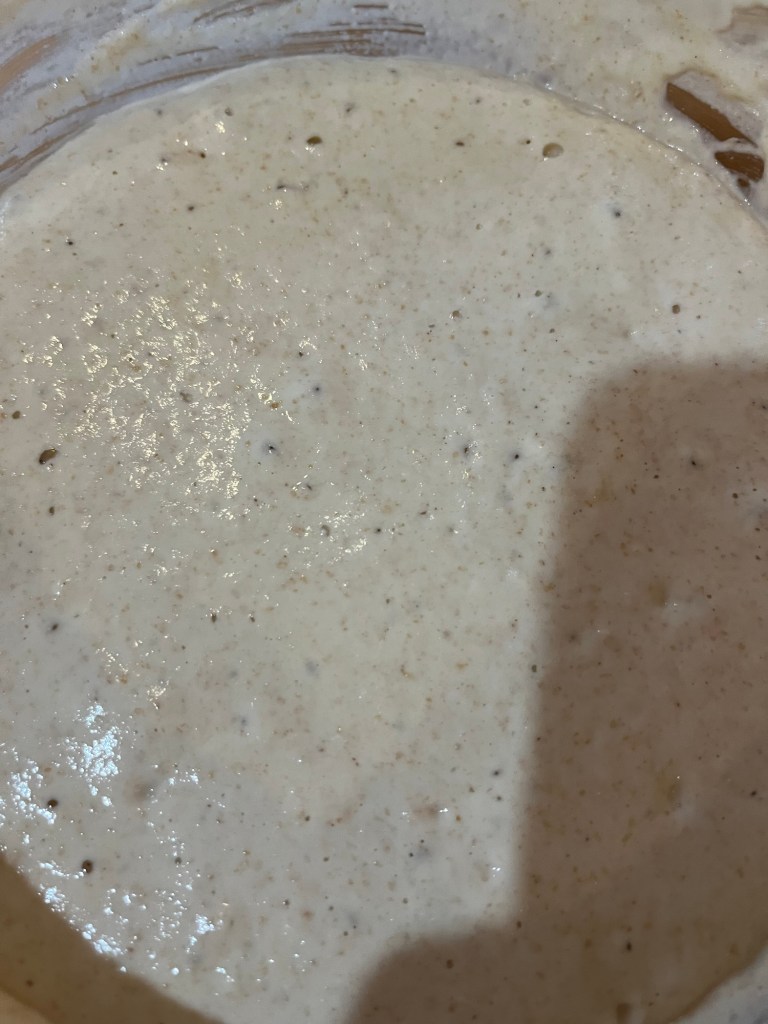
The next day things got really interesting. I phoned into my sister. I believe she was in the middle of finishing a fresco on her dining room ceiling. I think it was a pop art installation crossing The Persistence of Memory with Andy Warhol’s Campbell’s Soup cans in four stages. As she climbed down off her scaffolding, she looked at the screen to see that her bread – my bread – was now deemed to be ready to do more than simply feed with flour and water.
“Let’s get it prepped and ready,” she said while removing her painter’s smock and beret.
The next few minutes were a blur. I think I took a cup of the mix and transferred it to another bowl. To this I added water and more flour. I was instructed to toss-flip it, then rotate the bowl a quarter-turn and to repeat this until I had gone around the whole way. I asked if it mattered that I was turning the bowl counter-clockwise. I was roundly mocked. Given the other “technical specifications” surrounding this project I thought a detail like that would count for something. Ultimately there was more waiting, but not a full day’s worth. By nightfall I would find myself taking the new mixture, thoroughly toss-flpped and perfectly round-turned and balling it up with a “dusting of flour”, and leaving it in a bowl… overnight.
But back to that last phone call earlier in the day… “I have to say despite all the waiting, this has been a fun kind of science experiment. I’ve learned a lot and even though it took longer than I wanted and I had to eat a whole bunch of processed foods in the meantime, I think it might just be worth it.”
“Just one question,” I asked. “What do I do with the rest of the initial dough?”
She looked more puzzled than if I had asked why she was painting her ceiling.
“You mean the starter?” she replied. “You keep feeding it.”
It was at that moment it hit me.
“That wasn’t dough?” I half-asked and half-declared. “It was a starter!?”
Suddenly the entire process of making fermented bread became clear as though I had temporarily forgotten every science lesson I’d ever studied.
“So you’re telling me I’m stuck taking care of this bubbling bowl of mush for the rest of my life?” I asked. “Am I going to wake up to the Little Shop of Horrors in my kitchen screaming, ‘Feed me, Harvey!’”
Her reply? “Pretty much, yep.” And she went back to cultivating herbs on her kitchen window sill.
Then I crushed out a cigarette in the ashtray on my porch and proclaimed,
“Well… shit.”
I thought I was doing good for myself and my family. I thought I was growing in sanctity. I had begun to feel like a freakin’ pioneer only missing the Conestoga wagon. Most of all I had allowed myself to think that when the power grid eventually goes down in that fabled EMP strike, I, Harvey, would be able to do one of the most basic functions of humanity and bake a loaf of freakin’ bread.
The reality is I waited five days and picked up a story to tell. The bread was fine in the end. But all in all, I think I’d be better off learning to cultivate tobacco leaves and distill my own gin for the end times. Somewhere in New Jersey, a slightly unhinged, very wise, and always helpful grandmother who happens to be my sister has got me covered.


 Harvey Millican's Blog: Musings of a Trad Dad